
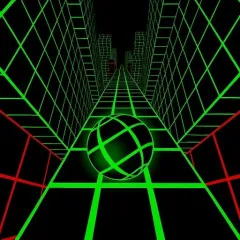
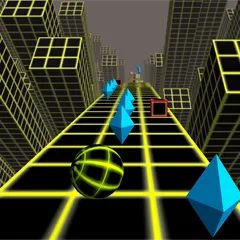




Use A or Left Arrow to move left, and D or Right Arrow to move right. On many phones the same idea maps to taps on each side of the playfield. When the path tightens, reduce side-to-side movement: aim for a straight, centered line and let momentum do the heavy lifting. Look slightly ahead of the ball so corrections stay small; wide swerves are expensive when the rim is only a few pixels away.
What's Slope 3 game?
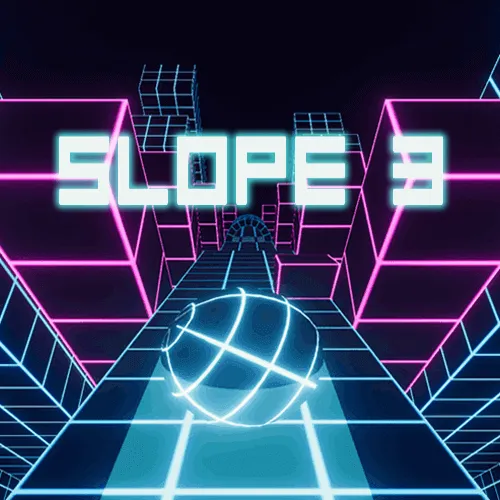
Slope 3 is the most demanding entry in the familiar neon ball-runner lineage: you steer a glowing sphere down an endless ribbon of track while the game quietly raises the stakes, faster rolls, wider jumps, thinner walkways, and hazards that won't give you time to think. The objective stays readable: survive as far as you can, keep the ball on solid ground, and avoid every red obstacle or die instantly. What changes is how often the course asks you to prove you meant that last micro-adjustment.
Compared with earlier outings in the series, Slope 3 leans harder into vertical drama and spacing tricks. Gaps feel larger, airtime shows up more often, and narrow segments punish side-to-side wobble, especially when they appear right after a high-speed drop designed to catch autopilot steering. The world itself fights back, too: platforms can shift or rotate, some sections tilt without warning, and red blocks arrive in clusters that force zigzag lines instead of a single lazy arc. Moving obstacles occasionally sweep across your lane, so spotting them early is not enough; you still have to weave through them. Any collision with red geometry or a fall into the void ends the run; there are no spare lives to spend your way out of a bad line.
Visually, the sequel keeps the neon-city-at-night language, clean geometry, high contrast, and motion that reads fast on both desktop and smaller screens. A leaderboard mindset fits naturally: each run is a clean experiment in focus, and the restart loop rewards players who treat failures as data. Below you will find controls (including pause), three practical steps, deeper notes on shifting track behavior, and an FAQ, then load the player and see how far your next calm run can carry you.
How to Play Slope 3
1
1. Own thin lanes with minimal steering
2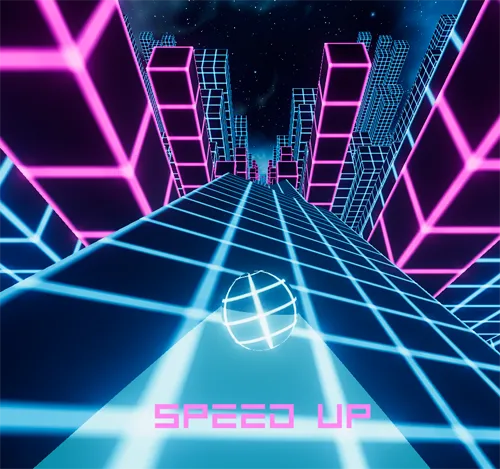
2. Read shifting ground before it moves you
Learn to separate stable floor from moving or rotating platforms, commit only when you know which pieces will still be there when the ball arrives. Expect sudden tilts that try to dump you off the edge, grouped red blocks that demand zigzag timing, and obstacles that slide across the lane. After big drops, assume the next segment is a trap: speed plus surprise is how the track turns a good run into a lesson.
3
3. Use pause wisely and chase clean distance
Press P or Esc to pause when you need a breath, then unpause with a clear plan for the next hazard. There is no mid-run revive: a red touch or a fall resets you to the start, so prioritize survival over hero plays. If the build exposes a leaderboard, treat each attempt as a training lap until your line choice stabilizes; small improvements in centering and hazard reads compound into much longer distances.
Why Slope 3 feels sharper than earlier slope runners
The core fantasy is still the same one-axis steering loop that made the genre addictive: forward motion never stops, mistakes are instant, and the scoreboard quietly asks for one more try. Slope 3 tightens the spacing vocabulary, bigger jumps, more frequent air, thinner ribbons of safe floor, so the skill shifts from “can I react?” to “can I stay smooth while the world rearranges under me?” That difference matters most when you are already at high speed and the track tries to trade your confidence for a panic swerve.
Moving geometry also changes how you should scan the lane. In calmer runners you can treat the next ten meters as a static puzzle; here you need a live model of what is attached to the world versus what is animating through it. The best players build habits: confirm footing, then adjust; never adjust blindly into a block cluster; never assume a platform will still be aligned after a jump. Those habits sound obvious on paper and expensive to learn in real time, which is exactly why the game stays interesting across hundreds of short runs.
How Slope 3 fits next to Slope, Slope 2, and cousins on this site
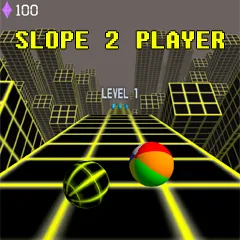
If you want the minimalist original vibe, the classic Slope page is the best reference point for how the formula started: fewer mechanical surprises, more pure lane discipline. Slope 2 on the homepage remains the flagship experience for many visitors, shop systems, gems, and a broader feature set depending on the build you play there. Slope 3 is the “turn everything up” sequel: more aggressive track motion, more demanding jumps, and a faster overall cadence.
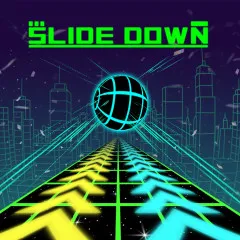
If you enjoy other neon endless variations hosted here, such as Slide Down with its rooftop booster pacing, you will still recognize the same muscle memory in Slope 3, but the obstacle dialect is tuned for players who already trust their hands and want sharper tests.
Tips for longer runs and steadier scores
- Default to center bias: it buys time when the lane kinks or a platform shifts under you.
- Plan the beat after every drop: assume a choke or moving hazard is waiting to punish autopilot.
- Zigzag with intent: clustered reds reward short, alternating taps, not one long carve.
- Pause is a tool, not a crutch: use P or Esc to reset your eyes, then commit to a clean line on resume.
- Protect your frame budget: close heavy background tabs if the embed stutters; precise steering hates dropped frames.
FAQs about Slope 3
Yes. You can launch it in your browser without installing anything. Performance depends on your device and network because the build streams inside the embedded player.
Use A or Left Arrow to steer left, and D or Right Arrow to steer right. Many mobile browsers map steering to tapping the left or right side of the play area. Press P or Esc to pause when you need a short break.
Yes, in typical builds you can pause with P or Esc. Exact behavior can vary slightly by host build, but pause is intended as a quality-of-life feature compared with strict no-pause runners.
No. Touching a red obstacle or falling off the track ends the run immediately, and you restart from the beginning, classic arcade rules.
The sequel pushes bigger jumps, tighter lanes, and more dynamic track pieces. Higher average speed plus less forgiving spacing makes small steering errors show up sooner.
Prioritize survival: smooth steering, early reads on moving platforms, and disciplined zigzags through red clusters. Retry quickly so each failure stays fresh in muscle memory.
Use the fullscreen control near the player when your browser offers it. On some phones you may need to tap the game surface once before fullscreen unlocks.