
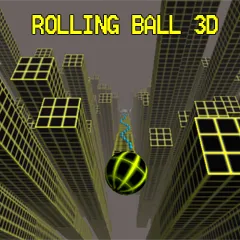






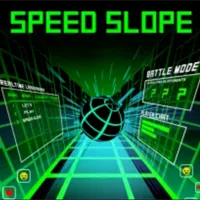


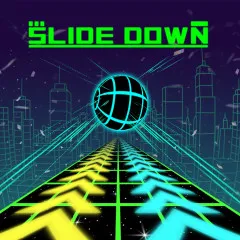
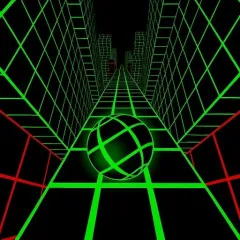
The ball moves forward automatically. On a keyboard, use the Left and Right arrow keys (or A and D, if the build maps them) to shift sideways. On phones, many layouts mirror steering with taps or drags on each side of the play area, follow whatever prompt appears on first load. Default toward the center lane whenever the geometry allows: it buys a beat when the path kinks, and a beat is often the difference between slipping through a gap and clipping an edge. Avoid long key holds unless the turn truly demands it; sawtooth steering is how clean runs die in one frame.
What's Slope Ball game?

Slope Ball is the kind of game that sounds simple until you are twenty seconds in: a ball rolls forward through a neon-lit course, the world tilts under you, and the only tools you get are quick lateral moves and a little nerve. There is no inventory screen, no story cutscene, and no gentle tutorial boss, just speed that creeps upward, red obstacles that end a run on contact, and empty space waiting for the first sloppy line. The challenge is modest: you are not climbing a mountain; you are keeping a ball on a narrow track while the track fights back.
What makes the loop compelling is how honestly it scales difficulty. Early mistakes feel like bad luck; later mistakes feel like delayed consequences of habits you picked up when the pace was still forgiving. Tight corners, sudden drops, and long straightaways that bait you into oversteering all share one lesson: momentum is not your enemy until it is. The course uses color and spacing like a language, bright lanes you want to trust, hazards you learn to recognize at a glance, and transitions that punish players who stare at the ball instead of the approaching geometry. Every restart is a reset of attention, which is why “one more try” is not a joke here; it is the whole point.
On this page you get the same presentation shell as the homepage, header, footer, a two-column layout with the green-line atmosphere, and a click-to-load embed so the game does not hijack bandwidth until you choose to play. Below the player you will find a practical three-step guide , deeper sections on reading the course and improving consistency, and an FAQ for controls and common failure modes. When you are ready, hit play, take a breath, and treat the first few runs as calibration: the scoreboard will still be there after you learn how fast “fast” becomes.
How to Play Slope Ball
1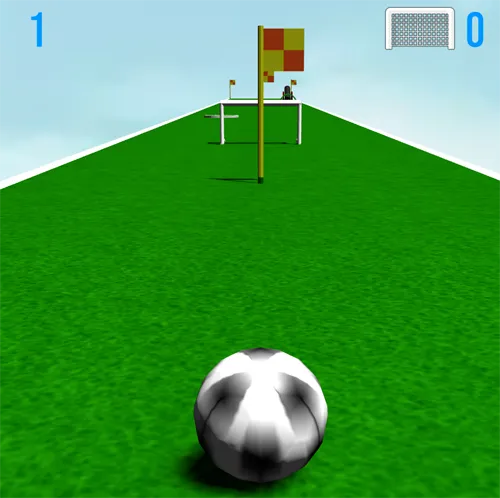
1. Steer with small inputs and favor the middle
2
2. Treat red blocks and ledges as instant failures
Anything that reads like a hard obstacle is exactly that: contact ends the run. Edges and missing floor behave the same way, there is no ledge-grab animation to save you. Scan two beats ahead so you are not surprised by a sudden choke or a diagonal wall that turns your “safe” lane into a trap. When the course opens up, do not confuse openness with permission to drift; wide sections often exist to set up a nastier turn on the other side.
3
3. Manage tempo as speed ramps
As you survive longer, the run accelerates. High speed does not require hero moves, it requires shorter corrections and earlier reads. If you feel yourself chasing the ball with frantic taps, slow your hands first: panic steering scales terribly with tempo. When you crash, restart immediately; short cycles turn mistakes into muscle memory faster than long breaks between attempts.
What the course is really asking you to do
Slope-style runners look like reflex tests, but the deeper skill is prediction. The track is not random noise; it is a sequence of spacing puzzles delivered at increasing velocity. A section that feels “unfair” on the first attempt often becomes readable after a handful of retries, because your eyes stop fixating on the ball and start tracking the lane the way a driver tracks the road rather than the hood ornament. That shift, from reactive swerving to proactive positioning, is the main skill gap between a lucky streak and a repeatable high score.
Geometry also teaches humility about greed. The fastest-looking line is not always the longest-lasting line. Sometimes the winning move is boring: give up a micron of centering to guarantee clearance, accept a slightly wider arc, and live to read the next hazard. Other times the layout rewards commitment, but commitment only works when you have already staged your approach two obstacles earlier. If you constantly “save” runs with last-instant flicks, you are borrowing against a bank that goes bankrupt the moment tempo spikes.
Finally, remember that failure data is data. When you die, you usually know whether it was oversteer, late recognition, or a bad gamble on a tight line. The game does not need a journal feature because your memory is the journal: replay the last three seconds mentally, adjust one variable on the next attempt, and compare outcomes. That iterative tightening is why these games remain popular years after their template became familiar, they reward clean thinking, not brute memorization of a single route.
How Slope Ball fits alongside other games here
If you are new to the genre, think of Slope Ball as a close cousin to the classic downhill ball runner: one primary axis of steering, endless forward motion, and a score tied to survival time or distance. Compared with puzzle-forward titles, there is less setup and more immediacy, you can understand the premise in one run and still be learning subtle timing fifty runs later. Compared with competitive multiplayer experiences, the opponent is the course and your own consistency, which makes it easy to squeeze in a session between tasks without committing to matchmaking or accounts.
On this site you can explore different flavors of the same fantasy. The flagship Slope 2 experience on the homepage is the natural anchor for many visitors, while classic Slope keeps the template lean and pure. Sequels and spin-offs such as Slope 3 and Slope 3D push different visual passes and obstacle dialects. Slope Ball sits in that same family: familiar steering loop, neon presentation, and a personal-best chase that survives because the fundamentals are tight.
If you enjoy alternating between “pure distance” sessions and shorter novelty runs, bookmark a couple of pages and rotate when your eyes get tired of one color palette. The skill transfers more than people expect, centering discipline and hazard vocabulary carry over even when the art style changes.
Practical habits for cleaner runs
- Look ahead of the ball: the lane you want tomorrow is decided by what you notice today.
- Steer in bursts: tap or tap-hold with intent; continuous micro-jitter turns into drift at high speed.
- Re-center after every correction: if you survive a tight squeeze, rebuild margin before the next squeeze.
- Keep the tab light: dropped frames make precise steering harder; close heavy background tasks if the embed stutters.
- Retry quickly: short cycles keep your hands warm and your reads honest.
None of these habits are glamorous, which is exactly why they work. Slope Ball is not asking you to master a twenty-button combo; it is asking you to stay calm while the world tilts faster. The leaderboard might as well be a chart of attention spans.
FAQs about Slope Ball
Yes. You can launch it in your browser without installing anything. Because the build loads through an embedded player, performance depends on your device, browser, and network.
On PC, use the Left and Right arrow keys (and A/D when supported) to steer sideways. On mobile, many builds map steering to taps or drags on the sides of the play area, follow the on-screen hints on first load.
Hitting red obstacle blocks or falling off the course ends the run immediately. There is no checkpoint revive in the classic template: you restart and try again.
This lightweight embed focuses on endless downhill scoring and reflex play. If you are used to mobile editions with cosmetics or currency, treat those as a separate product layer, the browser version here is about distance and consistency.
Difficulty ramps with survival time or distance in most slope runners. The course spacing stays readable, but your reaction window shrinks as speed increases, which is why early habits matter later.
Prioritize survival first: smooth steering, early reads, and conservative lines through tight sections. When tempo spikes, shorten inputs and trust boring centering over flashy edge work.
Use the fullscreen control near the player when your browser offers it. On some mobile browsers you may need to tap the game surface once before fullscreen unlocks.