
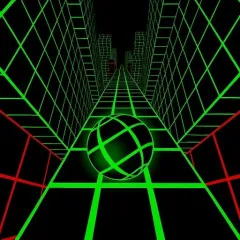
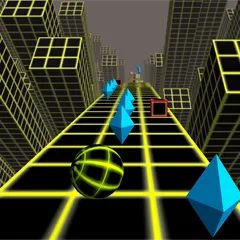

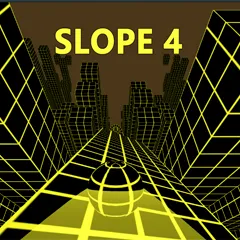


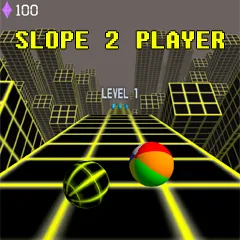


The ball accelerates downhill on its own. On PC use the Left and Right arrow keys or A and D to nudge sideways; on phones many builds accept swipes or tilts, follow the on-screen hints your device shows. Default to the center lane whenever the geometry allows: it buys milliseconds when the path kinks, and milliseconds are the currency of later sections. Keep corrections short; long holds turn into oversteer exactly when speed makes oversteer fatal.
What's Slope 3D game?
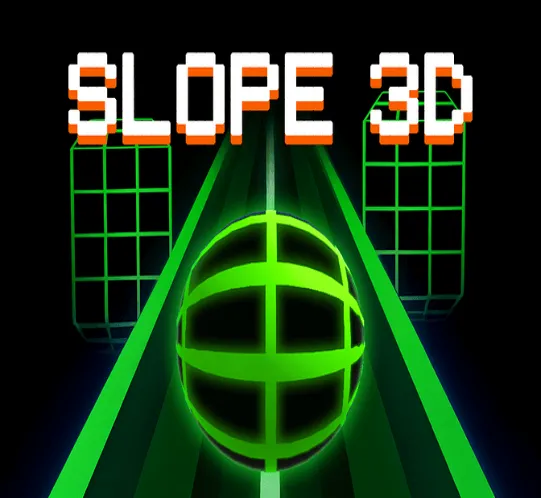
Slope 3D is an arcade endurance test dressed as a simple idea: a ball rolls forever down neon scaffolding suspended in open space, and your only job is to keep it on the ribbon. There are no brakes to lean on, no mid-run checkpoints to forgive a sloppy line, and no second chances once you clip the wrong geometry. What you do have is speed that climbs the longer you survive, sharper turns that appear without ceremony, and lane changes that punish players who steer by habit instead of by what the track is doing right now.
Compared with the leaner classic template, this build pushes graphical depth and spacing variety: the course reads in three dimensions more aggressively, bends feel tighter, and the difficulty curve is front-loaded into “stay centered, read ahead, micro-correct.” Obstacles lean on high-contrast red and black blocks, often placed so a glancing brush ends the run instantly, which teaches you to respect the margins. Diamonds appear along viable lines as optional pressure: they tempt you off the safest lane to bank score and unlock-style rewards, while downhill ramps can launch you over sudden chasms, useful when you pick a landing strip, punishing when you spot the gap too late.
The core is still the same loop, one axis of steering, rising tempo, instant failure, but the presentation sells vertigo and momentum more loudly. On this page you get the same site shell as the homepage (header, footer, two-column layout, and the green-line atmosphere), a click-to-load embed, three practical steps below, and an FAQ for controls and scoring quirks. Start a run when you are ready; the track will not wait.
How to Play Slope 3D
1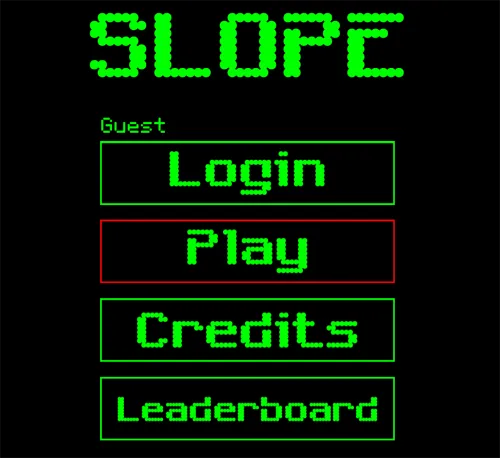
1. Steer early and favor the middle
2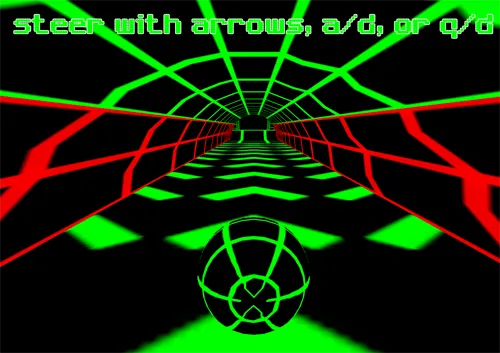
2. Respect hazards, gaps, and diamonds
Treat red and black obstacle blocks as hard stops, if you graze them, the run ends. Scan for gaps the course hides behind speed: use controlled speed and ramp angles to carry over chasms, but remember a big arc also increases fall speed on the way down, so pick a landing you can still steer out of. Diamonds increase score and feed unlock-style rewards when the build offers them; grab them only when the lane is honest, not when a greedy arc would trade a pickup for a respawn.
3
3. Read far ahead when tempo spikes
As distance grows, the ball’s pace becomes the real boss. When you are moving fast, steer with small taps instead of sharp turns, panic carving is how clean runs end in one frame. Do not stare at the ball; keep your eyes on the approaching ribbon so you can stage a line before the hazard occupies your lane. When the game accelerates suddenly, slow your hands before you slow your brain: calm inputs survive longer than heroic swerves.
What makes Slope 3D feel different from a flat endless runner
Many “runner” games flatten the problem into a single plane so your brain can cache patterns quickly. Slope 3D keeps reminding you there is air under the track: the camera sells depth, bends arrive with banking, and gaps punish players who only look one obstacle ahead. That extra spatial noise is not cosmetic, it changes how you budget attention. You are still making left-or-right decisions, but the correct decision is often the boring one: center early, confirm footing, then adjust.
The reward loop doubles down on risk versus score. Diamonds are deliberately placed where greed hurts, tight offsets beside blocks, slight detours before drops, so “collect everything” is a skill line, not a checklist. Ramps and downhill stretches are the other half of the contract: they can save a run by clearing a hole, or shorten a run by launching you into a bad angle. Treat them as tools with invoices, not free speed.
Where Slope 3D sits in the family of games on this site
If you want the minimalist roots of the genre, start with the classic Slope page, fewer visual layers, more pure lane discipline. Slope 2 on the homepage remains the flagship for many visitors, with its own feature mix depending on the build you load. Slope 3D is the “more chrome, more vertigo” cousin: louder 3D presentation, sharper corner vocabulary, and a faster sense that the track is trying to throw you.
If you like alternate takes on the same reflex fantasy, try Slope Unblocked or Slope 3, each page uses the same site shell but different obstacle dialects, so you can chase personal bests without feeling you are replaying the exact same lesson.
Gameplay tips that survive higher speeds
- Center by default: only hug edges when the layout forces a commitment.
- Look ahead of the ball: terrain reads beat reaction-time flexing every time.
- Tap steering at tempo: long key holds scale badly as speed ramps.
- Respect ramp exits: plan the landing lane before you leave the ground.
- Diamond discipline: skip pickups that require a hero line unless the score chase is worth the risk.
- Keep the tab light: frame drops make precise steering harder; close heavy background tasks if the WebGL build stutters.
FAQs about Slope 3D
Yes. You can launch it in your browser without installing anything. Because the build streams from an embedded host, performance depends on your device, browser, and network.
On PC, use the Left and Right arrow keys or A and D to steer. On phones and tablets, many builds support swiping or tilting, use whatever control prompt the embedded game displays on first load.
Hitting red or black obstacle blocks, even lightly, or falling off the track ends the run immediately. There are no checkpoints in the classic sense: you restart and try again.
Diamonds increase your score along the route and may unlock rewards or upgrades when the build includes that layer. They are optional risk: grabbing them safely is part of the skill ceiling.
Expect stronger 3D presentation, sharper turns, faster ramp-up, and more dramatic gaps. The core steering loop is familiar; the spacing and visuals push you harder.
Prioritize survival first, smooth steering, early reads, and conservative diamond routes. When speed spikes, shorten inputs and trust a boring line over a flashy one.
Use the fullscreen control near the player when your browser offers it. On some mobile browsers you may need to tap the game surface once before fullscreen unlocks.