
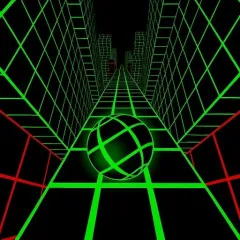
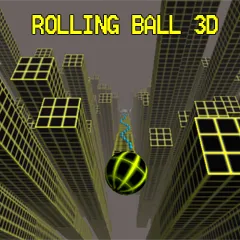
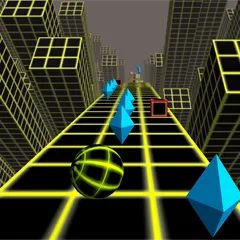






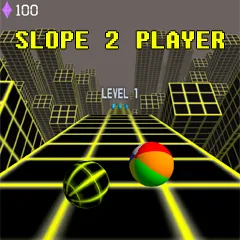
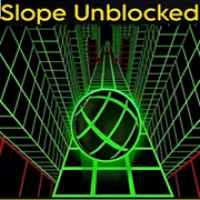
Use the Left Arrow or A key to move left, Right Arrow or D to move right. The most common mistake in Slope Run is holding a direction key through a turn. At any meaningful speed, a held input overshoots the gap and puts the ball into the wall or the void. Instead, tap and release. Brief inputs nudge the ball's line without committing to a drift. In the first 20 to 30 seconds of a run, use that low-speed window deliberately, not to go fast, but to feel exactly how much a single tap moves the ball at the current velocity.
What's Slope Run game?

Slope Run drops you into a fast-moving 3D tunnel suspended in space, with nothing between you and the void except your steering. The ball rolls forward on its own and picks up speed the longer you survive. Your only input is left and right, but that simplicity is deceptive. Turns get sharper, gaps appear with less warning, and red blocks cluster closer together as the run deepens. There are no checkpoints. One bad line ends everything and sends you back to zero.
What keeps Slope Run compelling is the gap between how easy it looks and how hard it actually gets. Early sections give you room to breathe and find your rhythm. A minute in, the track has narrowed, the obstacles have tightened, and the speed has climbed to the point where micro-corrections are the only reliable steering method. Big swerves cause overcorrection; held keys build momentum you cannot reverse fast enough. The runs that go furthest are almost always the quietest ones, small inputs, early reads, steady center position.
There is no shop, no progression system, and no unlocks. Just the score, the distance, and the next attempt. That stripped-back design is intentional, every restart takes seconds, the loop is tight, and improving your personal best is the entire reward structure.
What Slope Run actually tests
On the surface this looks like a pure reaction game, keep the ball on the track, avoid the red things, do not fall. That description is accurate but it undersells what is really being measured. Raw reflex speed alone will not carry you far; a fast reaction with no context gets you to the same wall slightly later. What Slope Run actually tests is your ability to read the upcoming track layout, make a steering decision, execute it cleanly, and then reset your attention to the next problem before the current one is fully resolved.
That skill, parallel processing of current position and future threat, is what separates short runs from long ones. The difficulty comes entirely from speed compressing the time window for each of those steps. Practicing Slope Run is effectively practicing that compression: the same read-decide-execute loop, done faster and with less margin for error as the run progresses. The no-checkpoint structure keeps everything honest, a 400-meter run was clean from zero to 400, not a grind through a middle section after getting lucky to a save point.
Obstacles and how to handle them
The obstacles themselves are not complex, but each type demands a specific response. Knowing what to expect before it appears is half the battle.
- Red blocks, the most common hazard. One touch ends the run. They appear singly or in clusters. On clusters, find the gap and aim for it two or three obstacle-widths before you arrive, not at the last moment.
- Track gaps, sections where the floor simply disappears. Speed carries the ball across short gaps automatically. The real danger is usually a red block waiting on the other side that you missed because your attention was on the gap itself.
- Narrowing corridors, the track shrinks to one or two ball-widths for a stretch. Enter from the center and make no unnecessary inputs until the path opens up again.
- Tilted platforms, sections angled left or right, causing the ball to drift with no steering input from you. A light counter-tap is enough to hold position. Over-correcting a tilt is one of the most common mid-run failure points.
- Moving hazards, appear in later sections, shifting across the lane on a repeating cycle. Watch one full cycle if the speed allows, then thread through the open window.
Why runs keep getting better with practice
Each run is different, which keeps the experience from becoming a memorization exercise. The gradual difficulty increase ensures even experienced players stay challenged, and the fast restarts make every failed attempt feel like useful data rather than wasted time. Reaction time improves naturally through repetition, and the key to real progress is developing rhythm, learning to balance instinct with observation rather than relying on either alone.
How to Play Slope Run
1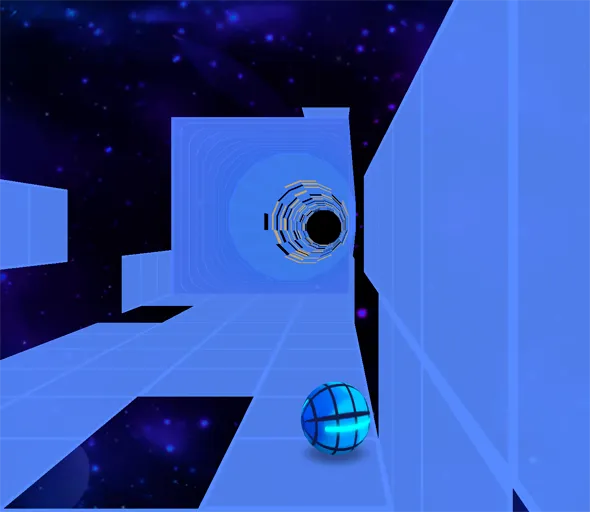
1. Learn to steer with short inputs, not held keys
2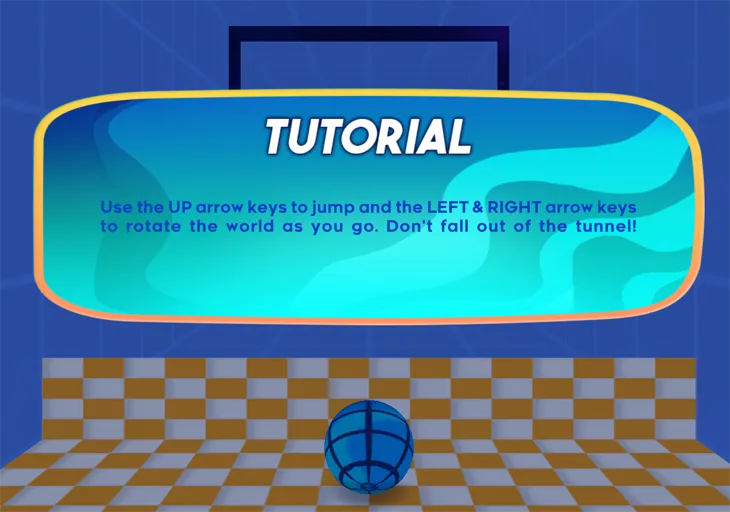
2. Shift your attention ahead of the ball
Watching the ball directly is the habit that ends most runs. By the time a gap or red block is directly in front of you, reacting to it is already too late at higher speeds. Move your gaze two to three seconds ahead along the track. Identify the next obstacle, note the safe lane, and steer the ball toward it before the hazard arrives. This one adjustment consistently produces longer runs because you stop reacting and start positioning. It takes a few attempts to build the habit but the improvement is immediate once it clicks.
3
3. Use center position as your default
Running near the center of the track gives you equal reaction space left and right. If you drift toward an edge, you lose that buffer in one direction and a surprise obstacle on that side ends the run with no recovery option. After every correction, return to center. It feels passive but it is a very active strategic choice, center position is where close calls become survivable instead of fatal. Narrow sections and fast turns are much easier to navigate when you arrive at them from the middle rather than from an edge.
FAQs about Slope Run
Yes. Slope Run runs in your browser with no download, no account, and no install required. Load the page and start playing immediately.
Steer the rolling ball left and right using the arrow keys or A and D. The ball moves forward automatically and speeds up as you survive. Avoid red blocks and gaps. Any contact with a hazard or fall off the track ends the run.
Keep your inputs small and brief rather than holding keys through turns. Move your attention two to three seconds ahead of the ball so you are positioning early rather than reacting late. Stay near the center of the track to preserve reaction space on both sides.
No. Hitting a red block or falling off the track ends the run immediately and resets you to the beginning. Restarts are instant and the loop is designed for rapid retries.
The opening stretch is forgiving enough to find your footing. After roughly 30 to 60 seconds of survival, the speed and obstacle density increase sharply and the game becomes a genuine reflex test. Short sessions and fast restarts make the difficulty feel fair even when runs end early.
The game loads in mobile browsers. Keyboard controls do not apply on touchscreens, so check whether the build you are playing supports on-screen touch controls or tilt steering before starting.